
 Deutsch
 English
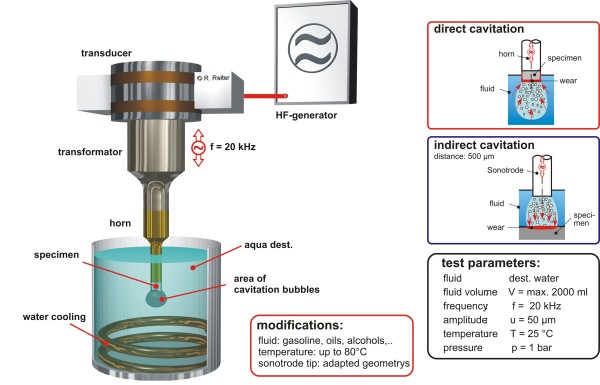
Cavitation test according to G32-16
Tests on vibration-induced cavitation stress are conducted at ISAF in accordance with the ASTM G32-16 standard.
The main components of the test stand (Figure 1) are:
- ultrasonic generator
- Piezoelectric transducer
- Transformer
- Sonotrode (base and tip)
Materials can be tested using either the direct or indirect method. In the direct method, the test specimen is screwed onto the sonotrode as a tip. In the indirect method, the specimen is positioned at a defined distance from the sonotrode’s end face. However, the sonotrode tip acts as a wear component even in this type of measurement.
In tests involving indirect cavitation, it is important to note that material damage progresses significantly more slowly than in tests involving direct cavitation. The tests can be conducted continuously or intermittently. In contrast to the continuous method, the intermittent method involves taking interim measurements. This makes it possible to determine whether wear increases linearly or nonlinearly. Before and after the test, the specimen is cleaned, dried, and weighed. In addition, tests on the surface roughness values Ra and Rz, the Abbott wear curve, and other materials science analyses can be conducted upon consultation.Test conditions that deviate from the standard—such as temperature, medium, test duration, and the shape of the sonotrode tip—can be varied upon consultation.