
 Deutsch
 English
Wear pot test
Wear pot tests involve two-body abrasive wear. Depending on the liquid content, either erosive or abrasive wear is simulated. For testing, the ISAF has three wear pots of different sizes (10 to 200 liters capacity) available, which can be used to simulate highly abrasive wear conditions. A wide range of achievable speeds, virtually unrestricted selection of abrasive type, size, and composition—including multimodal abrasives—and flexibility in test specimen geometry enable tribosystem-specific wear investigations, particularly in the fields of
- general equipment and mechanical engineering
- separation and filtration technology
- Raw material extraction and processing
- Conveying technology
- Building materials industry
- Earth-moving and excavation machinery
- Mining, deep drilling technology
- Agricultural soil cultivation
- Technical blades, e.g., for agricultural machinery, etc.
The stress angle can also be freely selected and depends on the specific application.
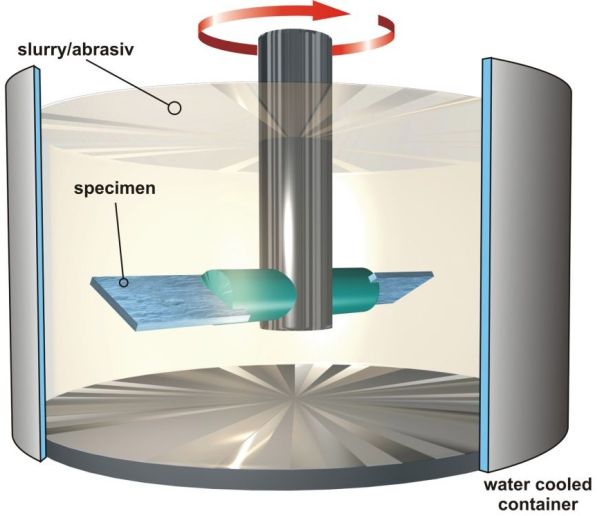
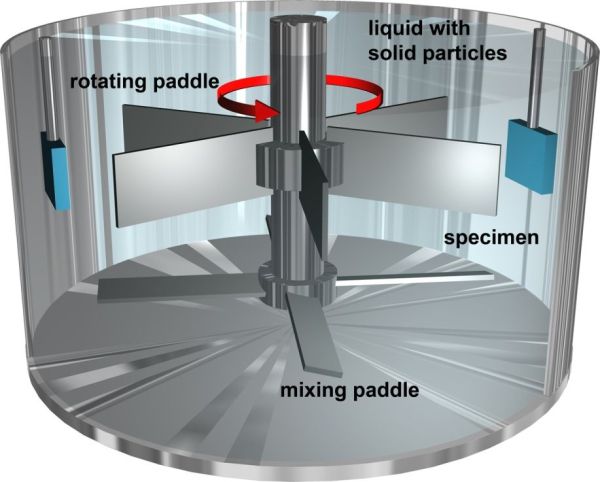
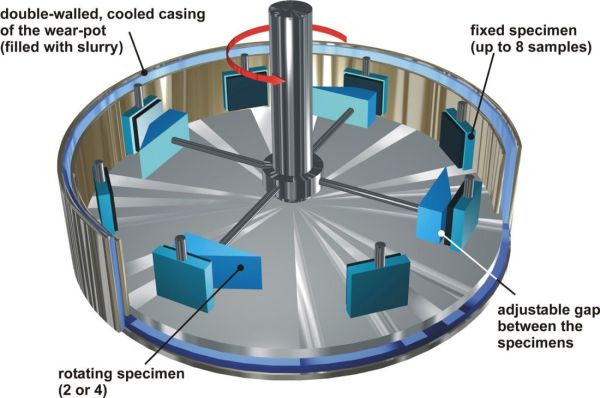
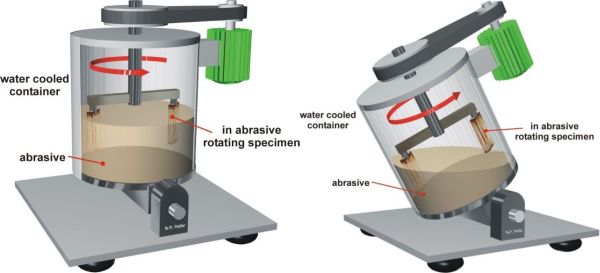
The wear pot method is used to test wear caused by loose particles. In this method, the specimens mounted on a rotor are passed through a solid-fluid mixture, figures 1 through 3. Due to the high mobility of the fluid, the specimens must be rigidly mounted in the test variant with a high liquid content to ensure sufficient relative motion between the specimen and the mixture, Figures 2. Depending on the mixing ratio of the mixture and the fluid, the specimens experience either abrasive-erosive or erosive-corrosive wear. For both solid and fluid selection, the ISAF offers a wide range of options, such as testing with paste-like substances or similar materials, Figure 3. This also includes tests with basic or acidic—i.e., corrosive—intermediate media. The specimens can be mounted at different angles to simulate an application-specific flow angle; with the largest wear pot, it is also possible to simulate abrasive-impact wear by tilting the specimen; Figure 4. All three pots are temperature-controlled, and their rotational speed and test duration are adjustable.